Pages

Showing posts with label how to bbq brisket. Show all posts

Thursday, December 27, 2012

Oven Baked Brisket

A few years ago, my younger self would have scoffed at the idea of cooking a brisket in the oven, but cold weather, darkness, lack of time, and the need for a potluck dish to feed up to 20 of my co-workers caused me to actually embrace the idea last week.

I used the Cook's Illustrated brisket recipe circu 2005 that I credit for helping me fine tune my competition brisket technique. After experimenting with the recipe a little bit back in the day I drastically improved the consistency of my brisket at KCBS contests. I would gladly post a link to the recipe if I could find one, but most of the links are to personal blogs and discussion boards that have reprinted the recipe from the published magazine. If I run across a direct link to the recipe, I'll post it here.


Whole brisket trimmed to make it a "flat".
I used a skillet for 7 minutes to help sear the meat side.

I flipped the brisket and skipped the skillet for another 7 minutes.

Then I carmelized some onions with a little brown sugar.

I don't have any more pictures of the process to share, but to summarize the onions were layered across the bottom of the pan with the brisket placed on top. I finished off the brisket in the oven for 3 hours at 300 degrees. At that point the brisket was 198 internal temperature.

I removed it from the oven and let it rest 30 minutes at room temperature before slicing. The slices were marinated in the au jus overnight in the refrigerator. The fat was skimmed from the surface before reheating.

The brisket was reheated for 25 minutes with some cooking wine and 2 tablespoons of rice wine vinegar as suggested by the original recipe.

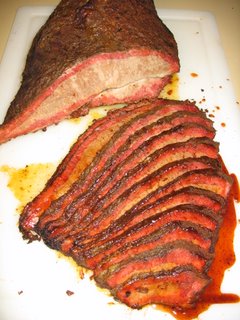
An oven cooked brisket will never compete directly with a smoker cooked brisket, but it was actually pretty good overall.

Saturday, June 02, 2012

BBQ Brisket Technique

Apologies to cat lovers, but just like that old saying "there's more than one way to skin a cat", there are several ways to cook a brisket.

  • Hot and fast
  • Low and slow
  • Fat side down
  • Fat side up
  • With foil
  • Without foil
  • Baste
  • No-baste
  • With injection
  • Without injection
I've experimented with all the techniques through the years, but during a Saturday afternoon practice cook using my Weber Smokey Mountain several years ago I stumbled on a hybrid method that combines the best of all those options.

1. Start the brisket fat side up and cook for 3 hours
2. Spritz with apple juice every 90 minutes to promote bark formation (I prefer Martinelli's)
3. Flip the brisket to fat side down and cook for 2 hours
4. Wrap in foil when brisket reaches 165 degrees (or after 5 hours)
5. Cook brisket to 194 degrees measured in the middle of the flat
6. Allow brisket to "rest" inside an Igloo cooler wrapped in towels for at least 2 hours (4 hours is even better)
7. Slice brisket with an electric knife (I use a Black and Decker)
8. Lightly sauce each brisket slice with Blues Hog BBQ Sauce before serving
9. Vacuum seal the  "extra" brisket slices and freeze to eat later when you get the craving

15 lb packer brisket fat side up


15 lb packer brisket fat side down

This technique works very well on my old Weber Smokey Mountain. It's won several dollars in bbq contests and it's won the hearts of family, neighbors, and co-workers for the past 10 years. This exact technique might not work the same way on an offset smoker, Big Green Egg, pellet smoker, etc. but perhaps through my trial and error experimentation you will find a golden nugget you like to assist with your brisket cooking results.

***
Want to learn how to make money online?
Click here

Thursday, December 17, 2009

The Brisket Movie - How to BBQ Brisket Pictorial

I've been playing around with Windows Movie Maker tonight and came up with this little "movie" about preparing a bbq brisket.


More background:

I use Certified Angus Brisket weighing about 13 pounds and a cooker temperature ranging from 200 - 250 degrees. I start them cooking fat side up and flip them to fat side down after 3 hours. I wrap the brisket in aluminum foil after it reaches 165 degrees internal temperature, or after 5 hours (whichever comes first). I cook my brisket to 198 degrees and let it rest in an Igloo cooler for at least 1 hour prior to slicing and serving.

Tuesday, August 25, 2009

Barbecue Brisket Weekend

Finished product. I cooked a 13 lb brisket for 8 hours with apple wood and sauced lightly with Blues Hog BBQ Sauce.

Weber Smokey Mountain cooking at 225 degrees.

Stem thermometer through the lid to monitor the temperatures.

Wednesday, June 10, 2009

How to BBQ Brisket

Brisket has become one of my favorite foods to barbecue. A pencil width slice of properly cooked brisket lightly coated with some Blues Hog BBQ Sauce is hard to beat.

I prefer to cook briskets in my Weber Smokey Mountain (WSM). I receive quite a few e-mails asking for help with barbecue brisket and thought I'd share some questions I received today.

Do you cook brisket with direct or indirect heat?
I use indirect heat and cook the brisket slowly at a temperature of 225-250 degrees.

Do you cook with fat cap up or fat cap down?
I begin cooking the brisket fat cap up for the first cooking segment. I don't flip until the brisket reaches 130 degrees or so. That's the point when the bark starts to harden a little bit. Then I flip it to fat side down. I used to skip this part but wanted a little more bark and found that this method will promote more bark formation.

Do you use foil?
I wrap in foil when the internal brisket temp is 165 degrees or if it's been cooking for at least 5 hours. Most of my briskets are completely done in 8 hours or so. I cook to an internal temp of 196-198 degrees and hold them in an Igloo cooler for a few hours to "rest" before slicing.

I hope this helps.

Sunday, September 14, 2008

How to Prepare and Cook BBQ Brisket

As loyal readers of the forum probably already know, brisket has become one of my favorite barbecued meats.

1. I started off with a visit to my local butcher and picked up a 16 lb. untrimmed brisket. I used to cook the brisket flats from Sam's Club, but after switching to "whole" briskets a few years ago, my results improved tremendously and so did my bbq contest results. A large, untrimmed brisket will cost $30-$35 depending on the weight and depending on whether it's a Certified Angus Beef (CAB) brisket. If it's available, I prefer CAB.


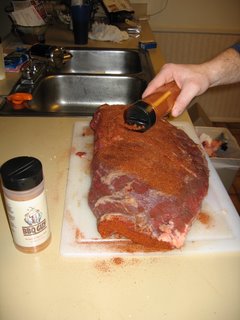
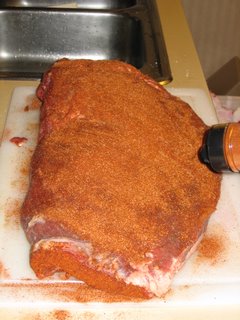
2. Last night I trimmed off some of the excess fat cap on the brisket, pierced the brisket with my Jaccard and rubbed it liberally with my Southern BBQ Rub. If you don't have a Jaccard, you can use a fork and pierce holes in the meat, which will allow the bbq rub to better penetrate the meat.


3. I placed the brisket in a double thickness plastic garbage bag and refrigerated it overnight. This allows time for the seasoning to penetrate the meat and also makes getting it on the cooker faster when it comes time to start the cooking process.


4. This morning I pre-heated the Weber Smokey Mountain to 250 degrees, added water to the water pan, removed the brisket from the refrigerator, and placed it directly on in the WSM. The health department recommends that meat spend less than 4 hours in the danger zone (i.e. internal meat temperature higher than 40 degrees and lower than 140 degrees.)

(I do not subscribe to the theory that allowing the meat to rise to room temperature will somehow improve the cooking results. I think it allows the potential for meat spoilage, although I’ve seen World Champion Barbecue Teams do it at competitions.)

5. Maintain cooker temp as low as possible near 190 degrees for as long as possible. I've found that the slower I can cook the brisket, the more consistent my results are.

6. I foil the brisket after about 5 hours, or once the bark begins to form.

7. I spritz with apple juice a few times during the cooking process as well. This seems to help with bark formation.

8. I continue cooking until the brisket temperature reaches 198 degrees.

9. I let the brisket set in an Igloo cooler for 3 - 4 hours before slicing it up.

10. After slicing, I sauce with my favorite bbq sauce. A brush works well for saucing each individual slice of brisket for even coverage.

Saturday, November 03, 2007

Aging Beef

According to the University of Minnesota Extension Service, beef flavor improves with age.

Their website explains that it's typical for beef carcasses to be aged about 7-days prior to butchering into retail cuts. The article goes on to explain that aging beef is more effective for older cows and for beef that is darker in color.

"in carcasses where lean was lighter in color, tenderness continued to improve during up to 16 days of aging....maintain the temperature at 30 to 35 degrees F while the beef carcass is being aged"

To learn more about the advantages, disadvantages, and risks associated with the aging process, visit the University of Minnesota Extension via the world wide web.


Competition BBQ Secrets

Tuesday, May 29, 2007

Brisket Cook


Here's a picture of the brisket we cooked on Sunday. It was taken just before we wrapped it in aluminum foil for the final 2 hours. The internal meat temperature at this point in the cooking process registered 168 degrees.

I've found that wrapping in foil between 165 and 170 degrees helps speed up the cooking process and also helps retain moisture in the meat. I've tried them without foil and didn't like the results.

Sunday, May 27, 2007

Brisket Barbecue

I'm cooking a packer brisket today that should be ready to eat just after the Indianapolis 500 finishes and just prior to the Coca-Cola 600 starting.

I prepared for the cook by purchasing a 12 pound packer brisket and trimming the biggest portion of the fat cap off.

My butcher always offers to perform the trimming for me, but I prefer to do it myself. By trimming myself, I end up paying for extra weight that ends up in the trash can, but in the end it's worth it because I can decide how much fat to trim off and how much to leave on. It's a delicate "grey area" because if you trim off too much, you risk drying out the meat. If you leave too much on, you will lose some bark formation on the meat itself.

I seasoned the brisket last night prior to bedtime and let it rest in the refrigerator overnight. The rub included a generous coating of sugar, Kosher salt, Spanish paprika, black pepper, onion granules, garlic granules, oregano, and three other "secret" ingredients that make my spice rub a winner on the competition circuit.

I'm cooking in my Weber Smokey Mountain today with some apple wood chunks for seasoning.

If you would like to sample the brisket rub yourself, it's available for purchase at The BBQ Guy's web site. It's earned several top finishes for me and several of my bbq friends in KCBS competitions.

Sunday, December 31, 2006

Barbecue Brisket Project

Here's another "Best of 2006" post from earlier this year. It's proved to be the single most popular post about cooking bbq on my blog this year.

Today's project is brisket.


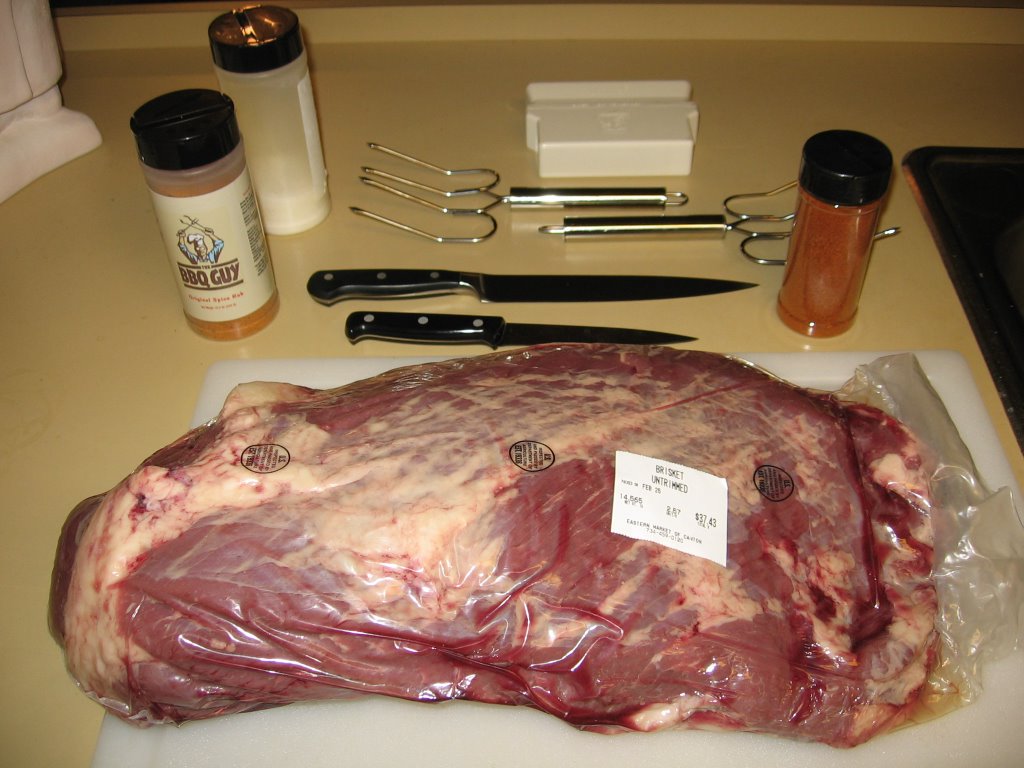
I purchased a 14 lb. Certified Angus Brisket at my local butcher shop. I had to order it because this type of specialty meat is not something they normally keep on hand, but it's one a handful of places that I've found that sells "whole" untrimmed briskets.

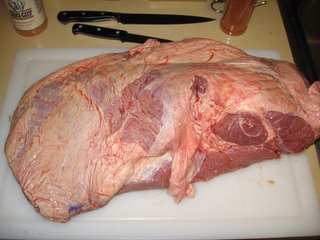
This is a picture of the fat cap on the CAB brisket I'll be cooking. At this point I haven't trimmed any of the excess.


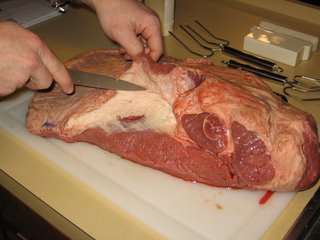
I begin to trim the fat. I remove much of the "hard" fat from the brisket. The knife tip is pointing toward a 1 1/2 - 2 inch portion of segment that runs between the "point" and the "flat".


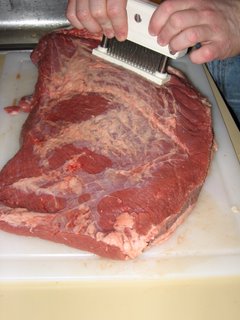
I use a special tenderizing tool called a Jaccard to pierce the meat before seasoning with my "secret" spice rub mixture. Piercing the meat allows the seasoning to penetrate deeper into the meat and also helps shorten the cooking time a little.


I start at one end and liberally apply The BBQ Guy Original Beef Rub to the both sides of the brisket. You can't use too much of this stuff. It's gooooooood.


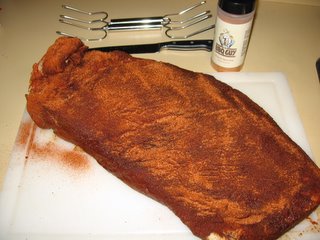
The rub is applied and the brisket is ready to marinade in the refrigerator overnight before cooking. I prefer to let the brisket set for 8-10 hours before cooking.


Here's a picture of the brisket after I removed it form the refrigerator the next morning just before placing it on the smoker for cooking.

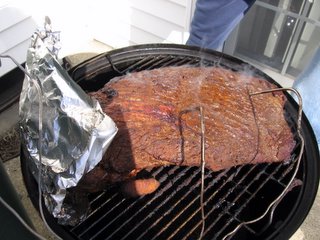
Here's a picture of the brisket cooking in the Weber Smokey Mountain (WSM). I've got a dual probe digital thermometer that I use to monitor the internal meat temperature on whole briskets. Brisket thickness varies quite a bit and like to monitor the flat in two places to ensure I don't over cook the meat.

Here's a picture of the final results.


Brisket Tenderizer Tool